
Education
M.S. in Hunan University, Civil Engineering (ARWU Top 15 Academic Subjects Worldwide), 2024
GPA: 3.49/4.00 Ranking:-
Curriculum: Numerical Analysis, Dynamics of Structure, Rock and Soil Dynamics, Advanced Soil Mechanics
B.S. in Hunan University, Civil Engineering (ARWU Top 15 Academic Subjects Worldwide), 2021
GPA: 3.68/4.00 Ranking: 7/128
Curriculum: Advanced Mathematics, Theoretical Mechanics, Mechanics of Materials, Structural Mechanics, Soil Mechanics
Publication
Zhang, C.*, L. Li, S. Hu, L. Gou, and R. Chen. 2024. “Physical origin of adsorption heat and its significance in the isotherm equation.” International Journal of Heat and Mass Transfer, 220: 124914. https://doi.org/10.1016/j.ijheatmasstransfer.2023.124914.
Li, L., Zhang, C.*, Hu, S. 2024. Hydrogen Bonding Network of Adsorptive Water in Variably Saturated Soil. Geotechnique (under review).
Zhang, C.*, Li, L., et al. 2024. Interactions with Soil Surfaces Contribute to Hydrologic Isotope Fractionation. Science (under consideration).
*:Supervisor
Experience
- Physical origins and significance of adsorption heat
- Adsorption heat is a cornerstone concept underpinning almost all the existing theoretical isotherms for porous media. However, it remains elusive what this concept stands for and the physical sources for it. This work elucidated the physical origins of the adsorption heat with the aid of the law of mass action, facilitating the establishment of a two-parameter sorption isotherm equation theoretically converted to two widely used adsorption isotherm equations.

- Adsorption heat is a cornerstone concept underpinning almost all the existing theoretical isotherms for porous media. However, it remains elusive what this concept stands for and the physical sources for it. This work elucidated the physical origins of the adsorption heat with the aid of the law of mass action, facilitating the establishment of a two-parameter sorption isotherm equation theoretically converted to two widely used adsorption isotherm equations.
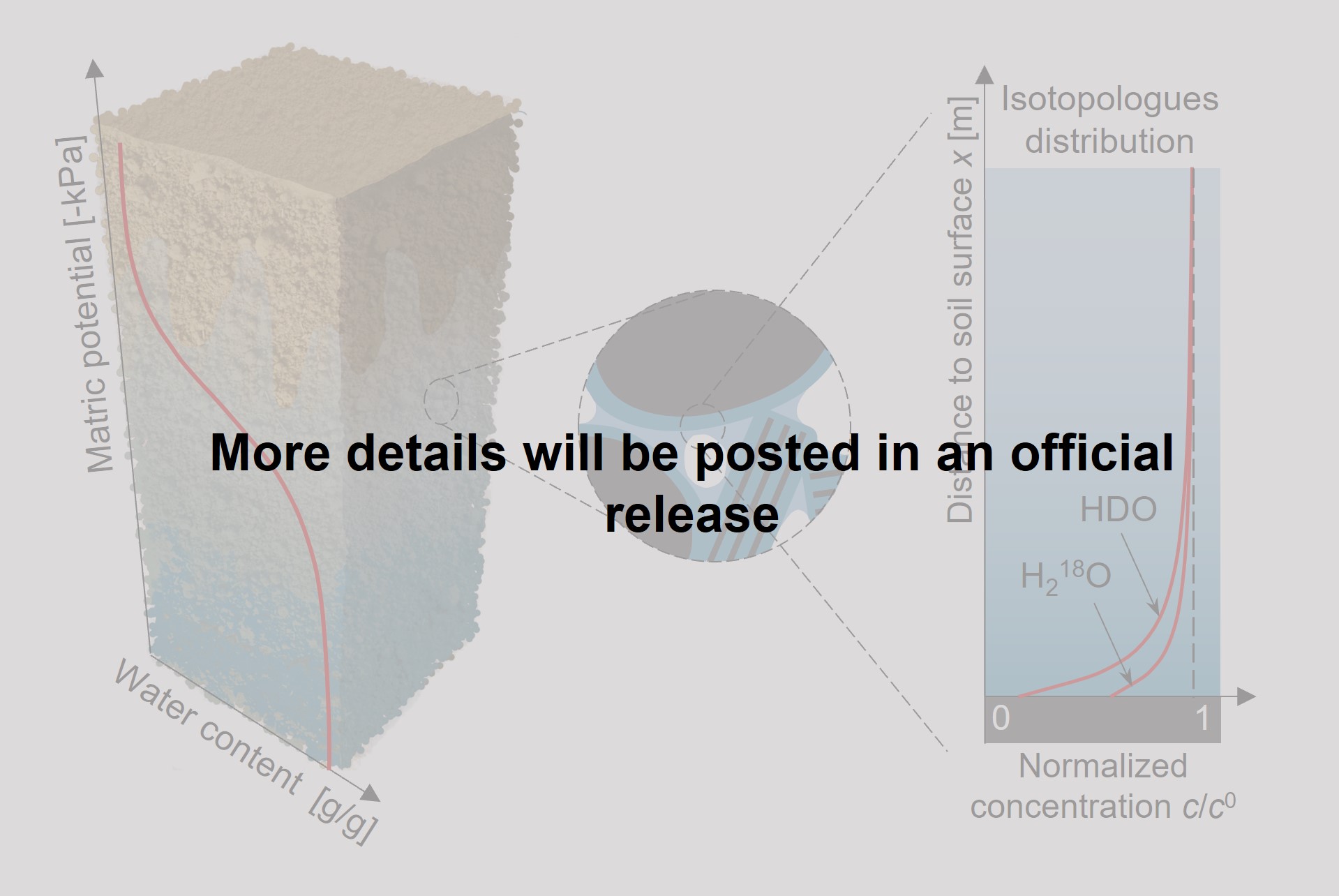
- Interactions with Soil Surfaces Contribute to Hydrologic Isotope Fractionation
- Notwithstanding its centrality in the terrestrial hydrologic cycle, soil water is practically absent in most isotope-based hydrology. Studies have shown distinctly different isotope fractionation behavior of soil water compared to bulk liquid water. Here, we show that at the microscale, the concentrations of D and 18O in soil water are depleted near particle surfaces, leading to a reduced equilibrium fractionation in soil water, that in turn, reduces the slope of soil water evaporation line relative to bulk liquid water. Integration of spatially varying soil water isotopologue concentrations from soil particle surfaces to the air-liquid phase yields a consistent framework for soil water isotope fractionation in agreement with measurements across different soil types. Additionally, this novel function is seamlessly incorporated into the classical two-source isotopic framework towards improving predictions of isotope-based partitioning of evapotranspiration. Predictions by the new framework demonstrate lower estimates of transpiration fractions compared to existing isotope-based formulations.
- Hydrogen Bonding Network of Adsorptive Water in Variably Saturated Soil
- Adsorptive water in soils exhibits a more structured hydrogen bonding (HB) network compared to bulk water. This structured hydrogen bonding network leads to unique physicochemical features of soil water, such as higher density and viscosity. However, accurately detecting the HB network water in soils remains challenging. In this work, vibrational spectroscopy, i.e., infrared spectroscopy and Raman spectroscopy, is employed to probe pore water structures in soils within a drying-wetting cycle. The obtained spectra are used to quantitatively characterize the water content, density, and viscosity evolution of adsorbed water in soils.

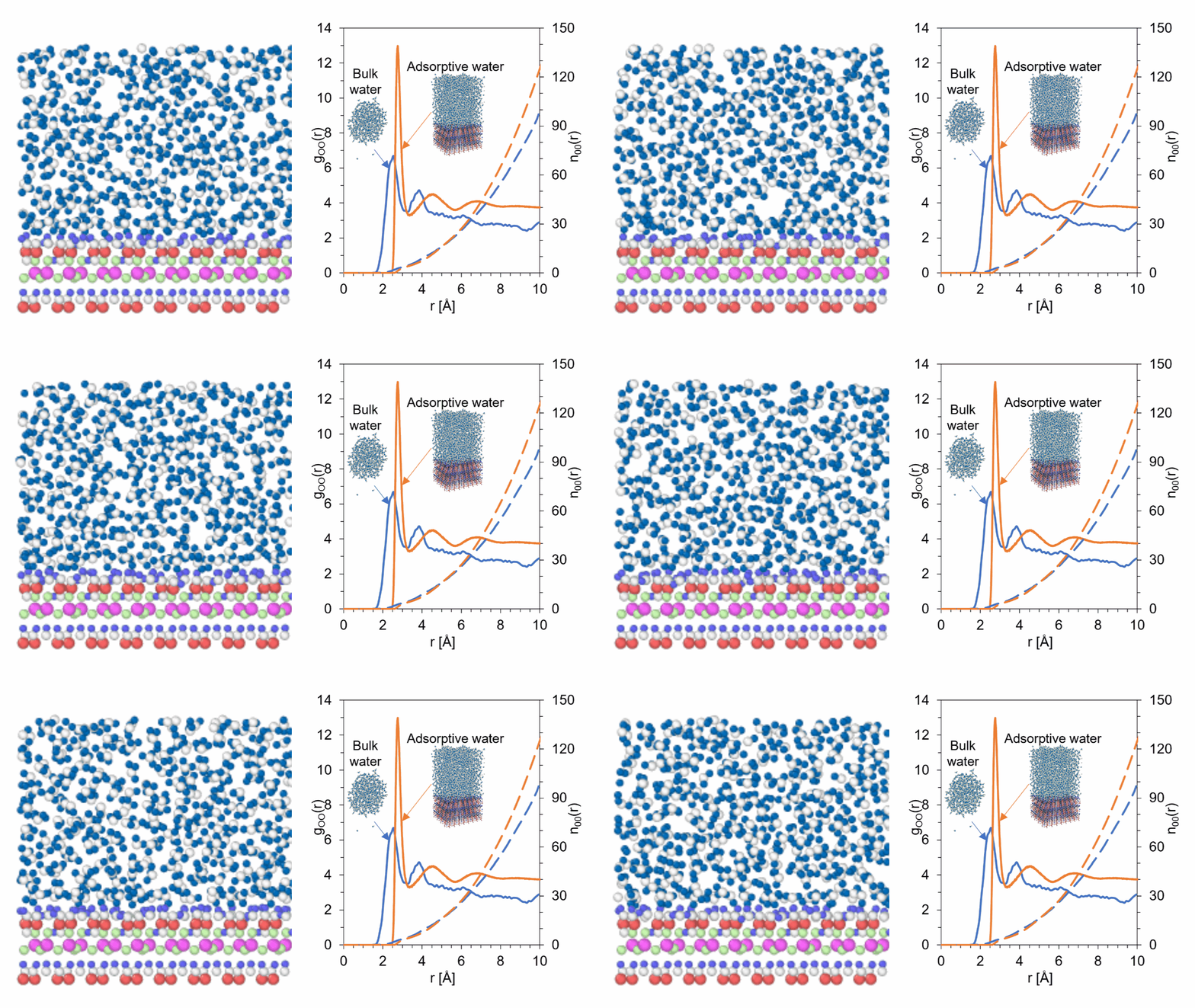
- Molecular simulation of water adsorbed on mineral
- Adsorptive water in soils exhibits a more structured hydrogen bonding (HB) network compared to bulk water, but accurately detecting the HB network density of adsorptive water in soils remains challenging. This work aims to utilize molecular simulation to quantitatively characterize the amount and density evolution of adsorbed water in soils within a drying-wetting cycle.
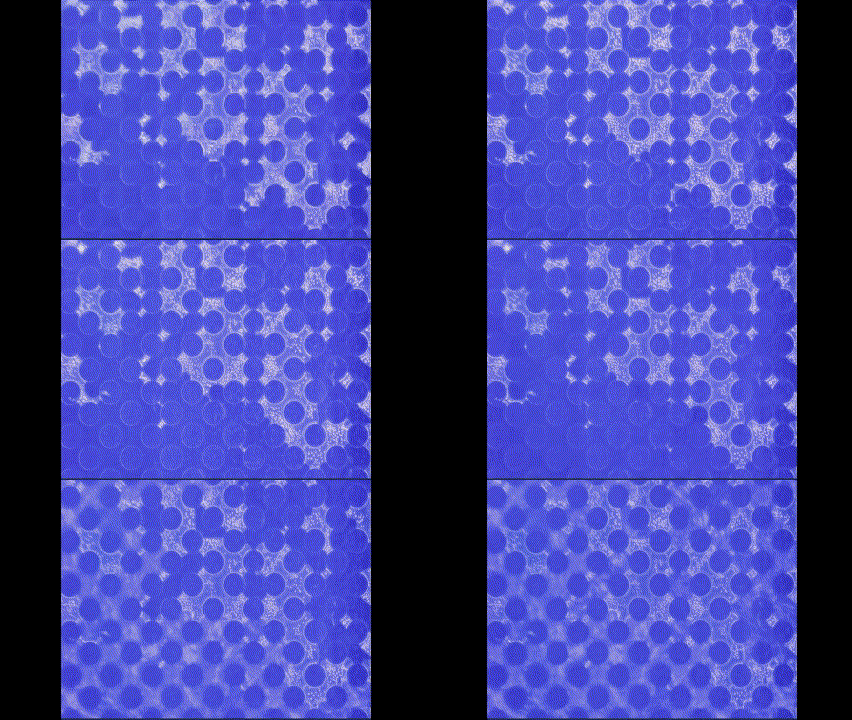
- Heterogeneous ice nucleation of salt solution in porous media
- To date, the freezing temperature depression behavior of the solution in porous media remains elusive which physical mechanism accounts for its freezing temperature and how dissolved ions affect it. This work designed a series of pore-scale experiments to investigate the freezing temperature of salt solutions in tubes with varying pore diameters, pore solution volumes, solid-liquid interface areas, ion concentrations, and ion types.
- Structure transition of high- and low-density ice
- Water confined in porous media exhibits both high- and low-density liquid forms, while ice can exist in high- and low-density amorphous phases (HDA and LDA). A longstanding debate in the literature concerns whether these amorphous ice phases correspond to two distinct liquid states. This work aims to investigate the high-to-low-density structural transition in ice confined within different saturated soils. Experimental evidence is obtained by integrating results from wide-angle X-ray scattering and differential scanning calorimetry, providing critical insights into the structural transformations under confinement.
- Nanopore Evolution in Clay during Drying via Small-Angle Neutron Scattering
- The evolution of the nanoscale microstructure of swelling soil under dry-wet cycling has a significant impact on its macroscopic hydraulic-mechanical properties. However, existing experimental techniques face huge challenges in quantitatively detecting the nanoscale microstructure of clayey soil. This work attempts to introduce small-angle neutron scattering technology to quantitatively characterize the nanoscale microstructural evolution of swelling soil. This study can provide new ideas and insights into the connection between the nanoscale microstructure of swelling soil and the soil-water interaction mechanism.
Skills
- Knowledge
- Unsaturated soil mechanics
- Thermodynamics
- Statistics
- Nucleation theory
- Scattering theory
- Finite difference method
- Mass-dependent and mass-independent fractionation
- ab initio theory
- Experiment skill
- Fourier transformation Infrared spectroscopy
- Small-angle neutron scattering
- Wide-range X-ray scattering
- Axis translation technique
- Differential scanning calorimetry
- Atomic force microscope
- Programming & Software
- Python
- MATLAB
- LAMMPS
- CP2K
- ANSYS
- Others
- Office
- LaTeX
- Sketchbook
- KeyShot
- IELTS test 7.0
Honors and Awards
- Outstanding Undergraduate Graduates of Hunan Province, Department of Education of the Hunan Province, May 2021
- First Class Scholarship of Hunan University, Hunan University, November 2020
- Champion of Hunan University Volleyball League, Jun. 2023-2024.